
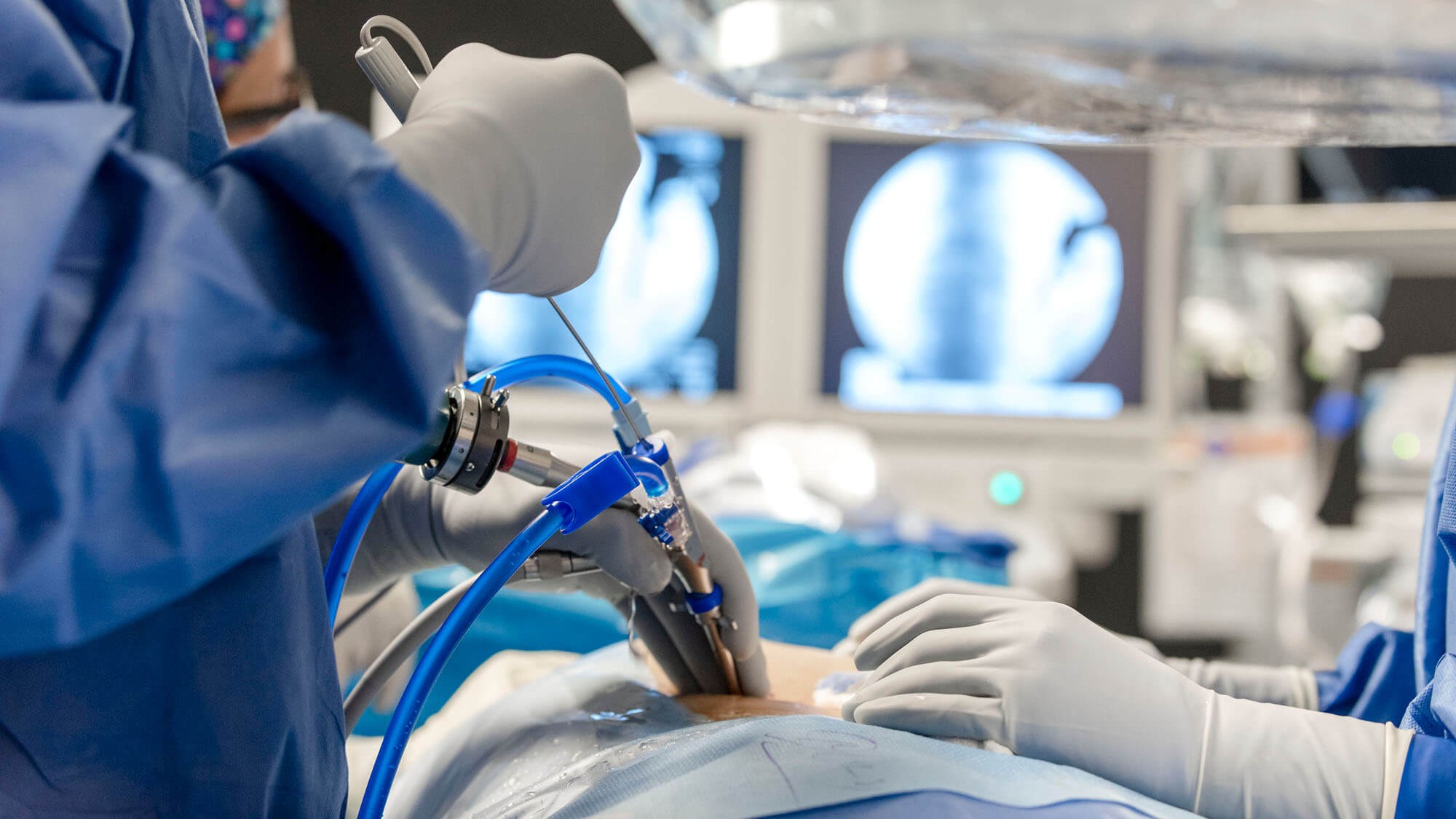
Endoscopic Spine Surgery in Delhi
Endoscopic spine surgery is an advanced minimally invasive surgical technique used to treat various spinal conditions, including herniated discs, nerve compression, and spinal stenosis.
The procedure uses a specialised instrument called an endoscope, which consists of a small camera and surgical instruments. It allows the surgeon to view the affected area of the spine and perform treatment through a small incision.
Unlike traditional open spine surgery, endoscopic spine surgery generally involves less muscle disruption and smaller incisions. It may help reduce postoperative discomfort, minimise blood loss, and support faster recovery in appropriately selected patients.
This technique can be used to treat certain cervical and lumbar spine conditions, depending on the patient’s diagnosis and clinical requirements.
What Conditions Can Be Treated with Endoscopic Spine Surgery?
Endoscopic spine surgery may be recommended for patients experiencing nerve compression or other spinal problems.
Herniated Disc: Removes the displaced disc material pressing against spinal nerves.
Slip Disc: Helps relieve nerve compression caused by a prolapsed or herniated disc.
Sciatica: Addresses selected lumbar conditions responsible for radiating leg pain.
Spinal Stenosis: Helps relieve pressure on spinal nerves caused by narrowing of the spinal canal or nerve passage.
Foraminal Stenosis: Creates additional space around compressed spinal nerves in selected cases.
Degenerative Disc Conditions: May help treat specific symptoms associated with disc degeneration and nerve compression.
Not every spinal condition is suitable for endoscopic treatment. The decision depends on imaging findings, symptoms and individual patient factors.
What Are the Benefits of Endoscopic Spine Surgery?
Endoscopic spine surgery offers several potential advantages over conventional open spine surgery, particularly for appropriately selected patients.
Smaller Incisions: Surgery is performed through small incisions, reducing disruption to surrounding tissues.
Less Muscle Damage: Specialised instruments help minimise damage to the muscles and soft tissues around the spine.
Reduced Blood Loss: The minimally invasive approach may help reduce blood loss during surgery.
Less Postoperative Pain: Limited tissue disruption may result in less discomfort after surgery.
Shorter Hospital Stay: Many suitable patients can return home sooner compared with conventional open procedures.
Faster Recovery: Patients may resume daily activities and rehabilitation earlier, depending on the procedure.
Preservation of Spinal Structures: The technique aims to preserve healthy muscles, ligaments and other supporting structures.
Actual benefits and recovery outcomes vary depending on the patient’s condition, surgical technique and overall health.
What Are the Types of Endoscopic Spine Surgery?
Different endoscopic techniques are used depending on the location and nature of the spinal problem.
1. Transforaminal Endoscopic Spine Surgery
This technique accesses the affected disc through the neural foramen, the opening through which spinal nerves exit. It is commonly used for selected lumbar disc herniations.
2. Interlaminar Endoscopic Spine Surgery
This approach accesses the spinal canal through the space between adjacent vertebral laminae. It may be used to treat certain disc herniations and spinal stenosis.
3. Uniportal Endoscopic Spine Surgery
A single small access point is used for both the endoscope and specialised surgical instruments.
4. Biportal Endoscopic Spine Surgery
Two small access points are created, one for the camera and another for surgical instruments. This provides flexibility when performing selected decompression procedures.
How Is Endoscopic Spine Surgery Performed?
The procedure is planned according to the patient’s diagnosis and MRI findings.
Preoperative Assessment: The surgeon reviews medical history, symptoms, physical examination, and imaging reports.
Anaesthesia: Appropriate anaesthesia is administered based on the procedure and patient requirements.
Small Incision: A small incision is made near the affected spinal region.
Endoscope Insertion: A specialised endoscope with a camera is inserted to visualise the surgical area.
Treatment: Specialised instruments are used to remove the problematic disc material or relieve nerve compression.
Closure: The instruments are removed and the small incision is closed.
The exact surgical steps vary according to the endoscopic approach and spinal condition.
Who Is a Suitable Candidate for Endoscopic Spine Surgery?
Endoscopic spine surgery may be suitable for patients who:
Have a confirmed herniated or prolapsed disc.
Experience persistent sciatica or nerve-related pain.
Have selected cases of spinal or foraminal stenosis.
Have not experienced sufficient relief from non-surgical treatment.
Have imaging findings that correspond with their symptoms.
Are medically fit for the recommended procedure.
Patients with significant spinal instability, extensive deformity or certain complex spinal conditions may require alternative surgical approaches.
Recovery After Endoscopic Spine Surgery
Recovery depends on the type of procedure, the severity of the spinal condition and the patient’s overall health.
Many patients can begin walking relatively early after surgery. A gradual return to routine activities is encouraged under medical supervision.
The recovery process may include:
Following postoperative instructions and wound care.
Avoiding heavy lifting and strenuous activities initially.
Performing recommended rehabilitation exercises.
Maintaining proper posture and spinal alignment.
Attending follow-up appointments to monitor recovery.
Best Endoscopic Spine Surgeon in Delhi
Dr. Puneet Girdhar is an experienced orthopaedic spine surgeon specialising in robotic and minimally invasive spine surgery at BLK-Max Super Speciality Hospital, New Delhi.
With over 25 years of experience and more than 10,000 spinal procedures, he provides specialised evaluation and treatment for various spinal conditions, including slip disc, herniated disc, spinal stenosis and degenerative disc disease.
His approach focuses on accurate diagnosis, individualised treatment planning and advanced surgical techniques, including endoscopic and minimally invasive spine procedures.
Patients experiencing persistent back pain, sciatica or nerve compression can consult Dr. Puneet Girdhar to understand whether endoscopic spine surgery is an appropriate treatment option.